
This time, I joined National Central University’s USR team at the Luofu Civic Activity Center to help organize a Basic Trauma Life Support (BTLS) course covering bleeding control, bandaging, immobilization, and casualty transport. I had expected the course to be rather serious, perhaps filled with unfamiliar technical terms. Once it began, however, I found that the instructor used simple memory aids and everyday examples to make the skills easy to understand. The session was full of interaction and laughter.
Most participants were older adults aged 65 or above, and everyone was actively engaged. At the start of the course, the instructor asked whether anyone had experienced a serious injury. Participants immediately began sharing their stories, with broken bones being the most common example. Drawing on familiar experiences helped everyone open up and made first aid feel more relevant to their lives. During breaks or while waiting to practice, participants also chatted with us and shared amusing everyday stories. We could sense how much they valued the activity and enjoyed learning together.
The instructor first explained how to recognize severe bleeding, using three Chinese keywords—“spurting, soaked, and severed”—to help participants remember the warning signs. Examples included spurting blood, clothing or dressings heavily soaked with blood, and traumatic limb amputation. We then practiced applying direct pressure to control bleeding. The instructor emphasized that pressure should not be repeatedly released just to check the wound. Even when emergency responders arrive, it should be maintained until they are ready to take over fully. This explanation helped me understand that first aid involves more than remembering steps; it also requires attention to the situation and a careful handover to responders.
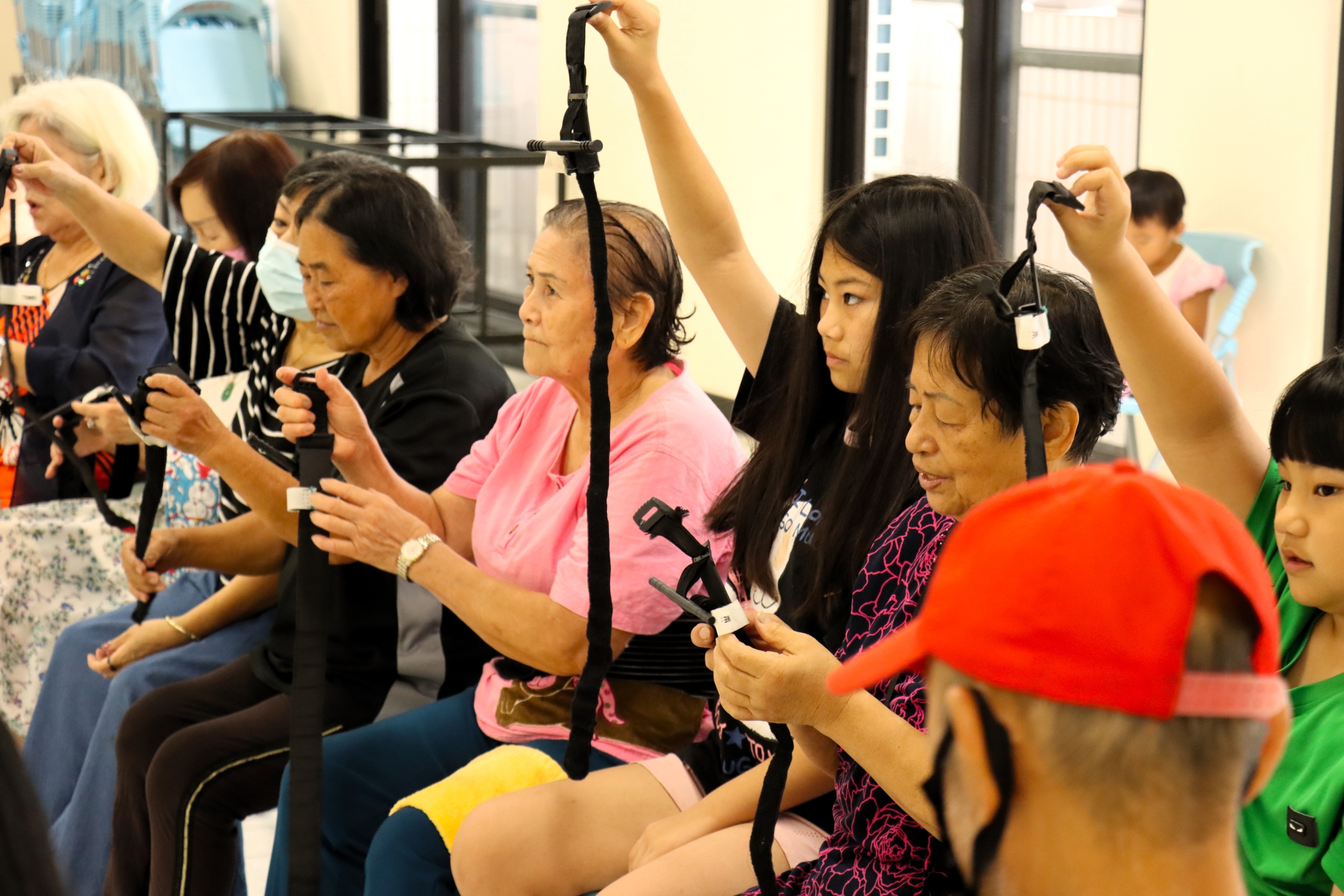
Next came practice in controlling bleeding from one’s own leg. The instructor handed out tactical tourniquets and introduced a three-step memory aid: “Pull, twist, secure.” Participants were then challenged to complete the exercise within 15 seconds. Only about half finished on the first attempt, prompting the instructor to joke, “That means half of you didn’t make it!” The room immediately filled with laughter. On the second attempt, some participants had already positioned their tourniquets around their legs, while those who finished early helped neighbors who were still unsure of the next step. By the third round, almost everyone completed the exercise successfully. What impressed me most was how naturally everyone looked out for one another and practiced together, revealing the close bonds within the community.
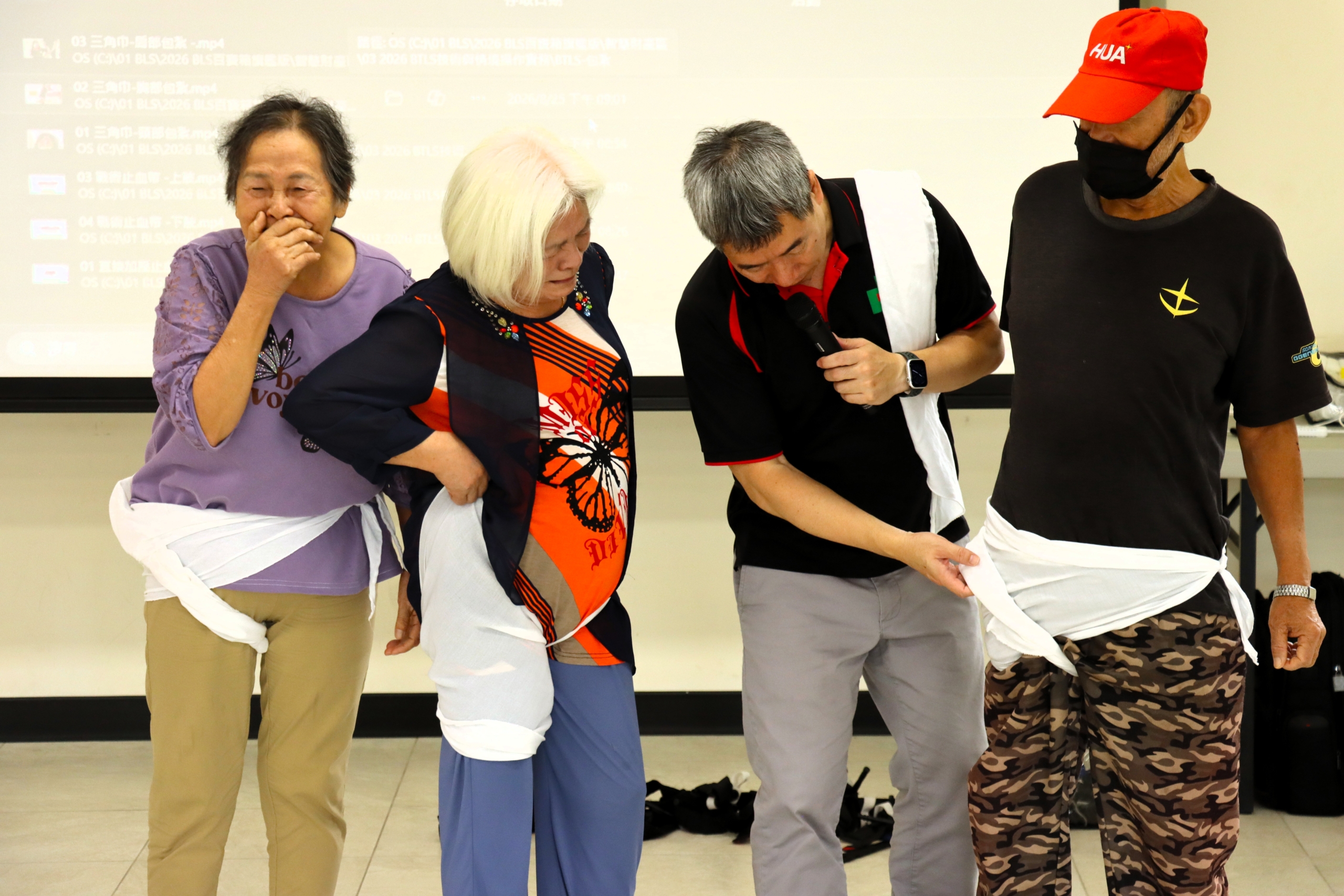
For triangular bandage practice, participants worked in pairs. One played the injured person, “A-Zhu,” while the other acted as the rescuer, “A-Hua,” before switching roles. They practiced bandaging the head, shoulder, and abdomen. In addition to showing demonstration videos, the instructor visited each pair to check their technique, occasionally using colloquial Taiwanese phrases to remind them to adjust the tension. These familiar expressions made the atmosphere even more lively.
One particularly interesting challenge was to adapt the shoulder-bandaging technique: how would they bandage an injury to the buttocks? This time, there was no demonstration to follow directly, so each pair had to discuss and experiment. Several groups successfully worked out the correct method. When a technique needed adjustment, the instructor used everyday items such as diapers as comparisons to explain how different wrapping methods provided support, helping participants understand the purpose behind bandaging.
The participants went on to learn spiral and figure-of-eight wrapping with elastic bandages, along with cervical spine stabilization, pelvic stabilization, upper-limb splinting, and arm slings. The instructor also gave examples of how available objects might be used to help immobilize an injury when specialized equipment is unavailable. At this point, one participant remarked, “We really should keep more tourniquets and triangular bandages up in the mountains.” That brief comment showed me that participants were already thinking about how the day’s lessons related to their own living environment.
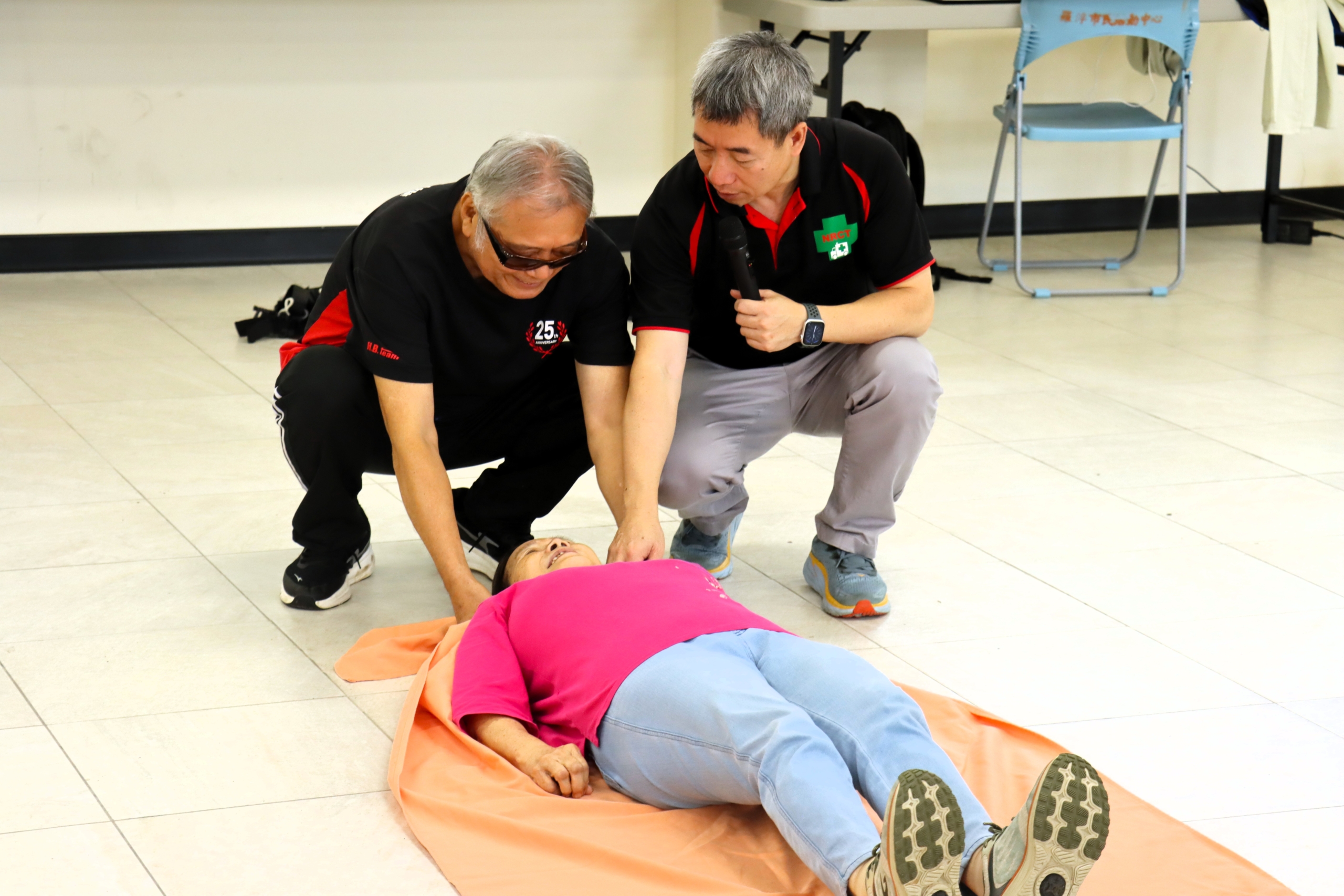
The casualty transport session was one of the liveliest parts of the course. The instructor introduced the firefighter’s carry, sheet carry, extremity carry, two-person hand-seat carry, and two-person assisted walking. When the hand-seat carry was introduced, someone immediately said they had done something similar as a child. The instructor then invited a group to the front to learn and demonstrate the technique under guidance. The volunteers were especially outgoing, and their interactions had the audience laughing throughout the demonstration, making a seemingly difficult technique easier to understand.
At the end of the course, the instructor reviewed four key areas: bleeding control, bandaging, immobilization, and casualty transport. Participants were also reminded that priorities must depend on hazards at the scene and the injured person’s condition. Only then did I realize that the entire course—from recognizing severe bleeding to practicing transport—had been structured around these four areas all along. What I admired most was the instructor’s ability to turn a serious subject into something everyone could understand and was willing to practice, using memory aids, humor, and familiar experiences.
This activity reminded me that people of any age can learn first aid. The older participants showed just as much engagement, curiosity, and energy as younger learners. Some helped their neighbors after mastering a skill; others laughed and tried again when a bandage went wrong; and many readily shared their experiences when the instructor asked a question. Three hours may not be enough to turn everyone into a professional responder, but the course gave participants greater confidence that they could do something to help in an emergency. For me, that was the most meaningful takeaway from this BTLS course.
Written by Shu, Cheng-Jui
Edited by Li, Ruo-Jia
Photos by Shu, Cheng-Jui