
Background and Objectives
National Central University’s mbhoyaw “Fuxing” University Social Responsibility (USR) Project has maintained a long-term partnership with Luofu Senior High School to promote Atayal weaving education. During discussions about the project’s direction for the coming year, teacher Wang Hsiu-Ling expressed a wish to explore new possibilities for Atayal ramie weaving through modern technology and cross-cultural exchange. She also hoped to connect with Japanese jōfu artisans to exchange knowledge about ramie cultivation, fiber extraction, yarn making, dyeing, and weaving.
Japanese jōfu is handwoven from fine ramie yarn and is known for its lightness and breathability. Its production involves intricate processes, including fiber preparation, hand-splicing, plant dyeing, and kasuri patterning. In addition to learning these techniques, the visit aimed to draw insights from Japan’s experiences in transmitting traditional crafts and incorporating them into everyday life. These insights would inform weaving education undertaken by the project team and local partners while establishing connections for future Taiwan–Japan collaboration.
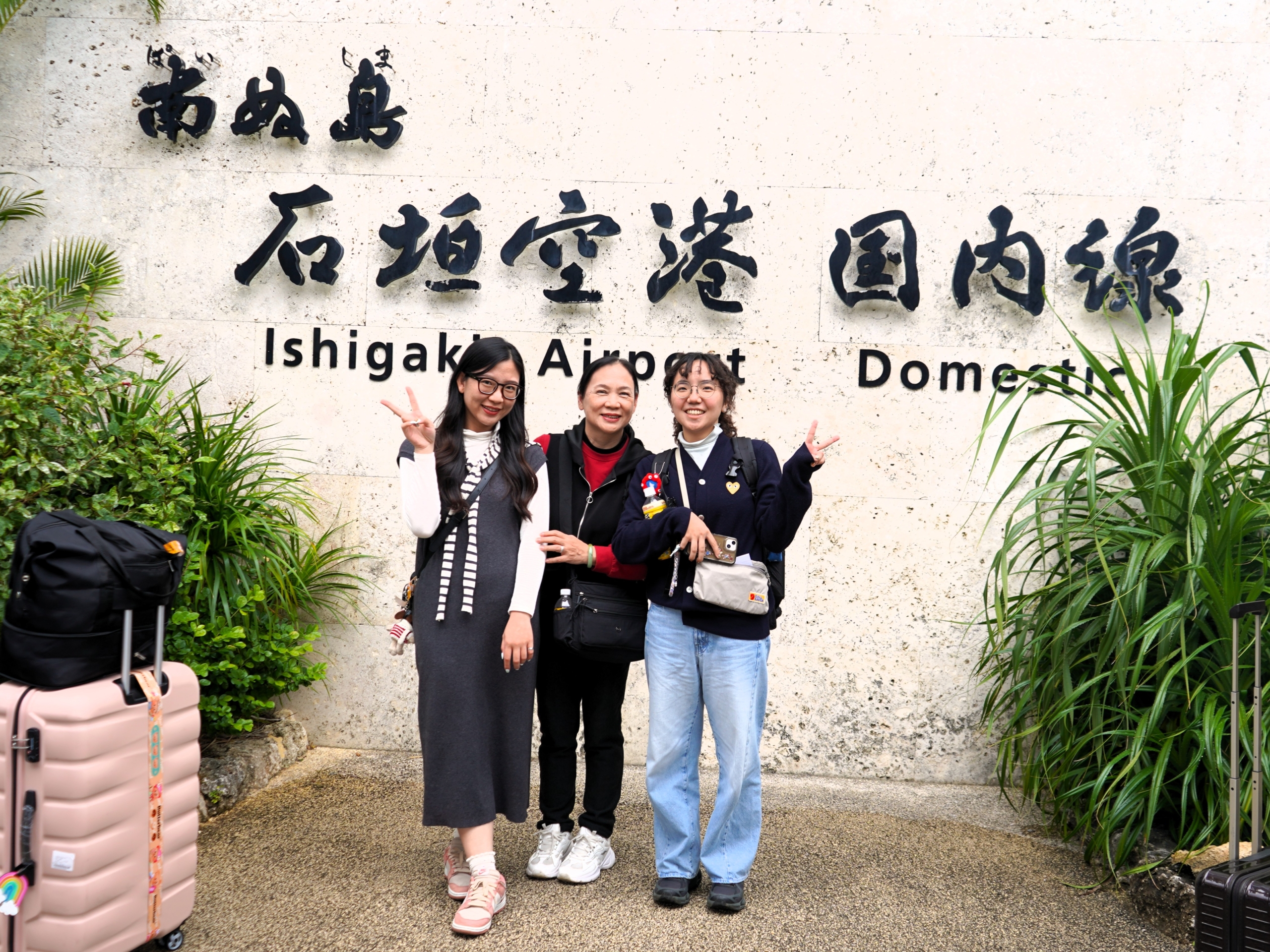
The visit was made possible through connections established during an earlier field course on Ishigaki Island organized by NCU’s “Taohai Sansheng USR Project.” Local young resident Yusuke Odomari helped connect the team with Yaeyama jōfu artisan Kimiko Matsutake. From January 27 to 29, 2026, the delegation visited Ishigaki Island and Okinawa’s main island. Led by Associate Professor Tsai Hsi-Cheng of the Department of Mechanical Engineering, the delegation included master’s student Hsu Yu-Chun, whose research focuses on science, technology, and society; teacher Wang Hsiu-Ling of Luofu Senior High School; and Wang Yu-An, a specialist with an Atayal language promotion organization. Together, they approached the exchange from technological, educational, and cultural perspectives.
Exploring Ishigaki Island’s Weaving Culture
The team first visited the Ishigaki City Traditional Crafts Museum to learn about the history, tools, and production processes of Yaeyama jōfu and Yaeyama minsā weaving. Exhibits included shells formerly used to scrape ramie fibers, plant dyes, and weaving techniques, illustrating the close relationship between local crafts and the surrounding environment. The contrasting patterns produced through kōro-based stencil dyeing and Ryukyu indigo kasuri dyeing offered insights into the distinctive features of Yaeyama jōfu.
The museum also houses weaving classrooms, and the team happened to encounter learners arriving for lessons. Seeing people of different genders and backgrounds learning together highlighted that cultural transmission depends not only on preserving techniques but also on sustaining curiosity and enthusiasm. Hands-on practice helps deepen understanding and makes traditional crafts part of everyday life.
The delegation then visited the Yaeyama Minsā Craft Museum to explore minsā textiles woven from cotton yarn. Their characteristic alternating five-square and four-square motifs convey the meaning “forever,” expressing blessings and affection. The museum extends these traditional patterns to neckties, bags, and other everyday items. Through colors and lines, its textiles also depict Ishigaki Island’s ocean, beaches, and waves, combining practical use with artistic expression.
These works demonstrated how traditional crafts can retain their cultural identity while responding to contemporary life through changes in design and application. During the visit, the team also shared a publication produced in 2024 and records related to Atayal weaving with museum staff, exchanging cultural and research experiences.
Learning Yaeyama Jōfu with Kimiko Matsutake
On January 28, the delegation visited Kimiko Matsutake. The morning session covered ramie harvesting, peeling, scraping, and yarn making, followed by an afternoon weaving session on a Japanese treadle loom. Together, these activities introduced the full process of transforming plant fibers into textiles.
Matsutake first explained plant dyes and her indigo vat before guiding the team to her ramie garden. She noted that ramie grows more slowly in winter and requires greater effort to process, so winter is generally not the main harvesting season. Based on her observations, Wang Hsiu-Ling identified possible differences between ramie grown on Ishigaki Island and in Taiwan, including plant characteristics and fiber fineness, suggesting directions for future comparison and research.
During fiber scraping, the team tried local tools and shared the Atayal practice of processing ramie with bamboo implements. The Ishigaki tools allow users to work while standing, offering an alternative to sitting on the ground. This prompted the team to consider how tool design could address artisans’ physical strain and practical needs.
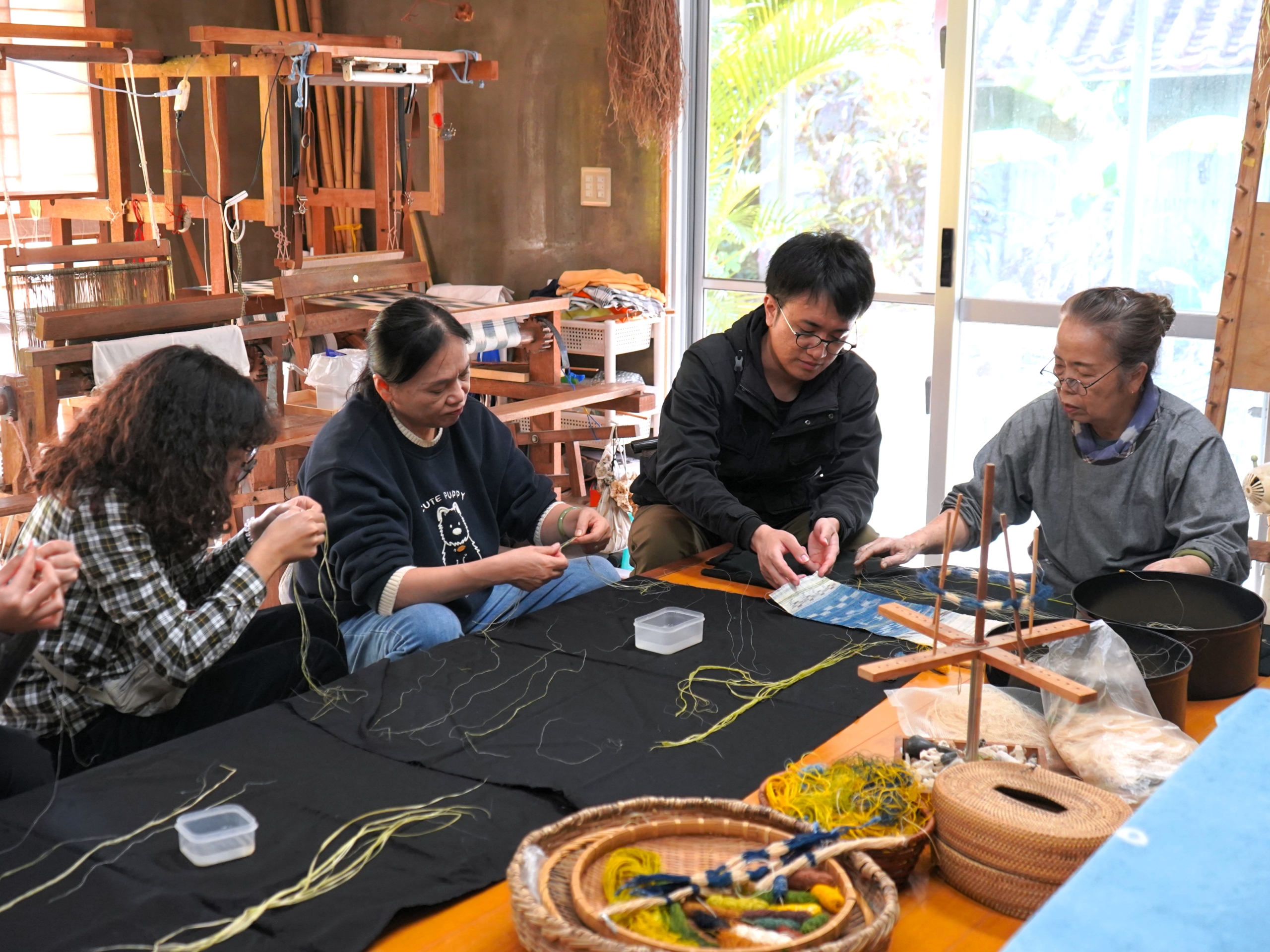
Yarn making was a key part of the exchange. Matsutake used black cloth as a background to help learners distinguish fine fibers, then demonstrated fiber splitting and splicing. Although the movements appeared simple, performing them required considerable concentration. Weak joins or uneven thickness could affect subsequent weaving. Through practice, the team gained a deeper appreciation of how the fine, soft texture of Yaeyama jōfu depends on patience and experience at every stage.
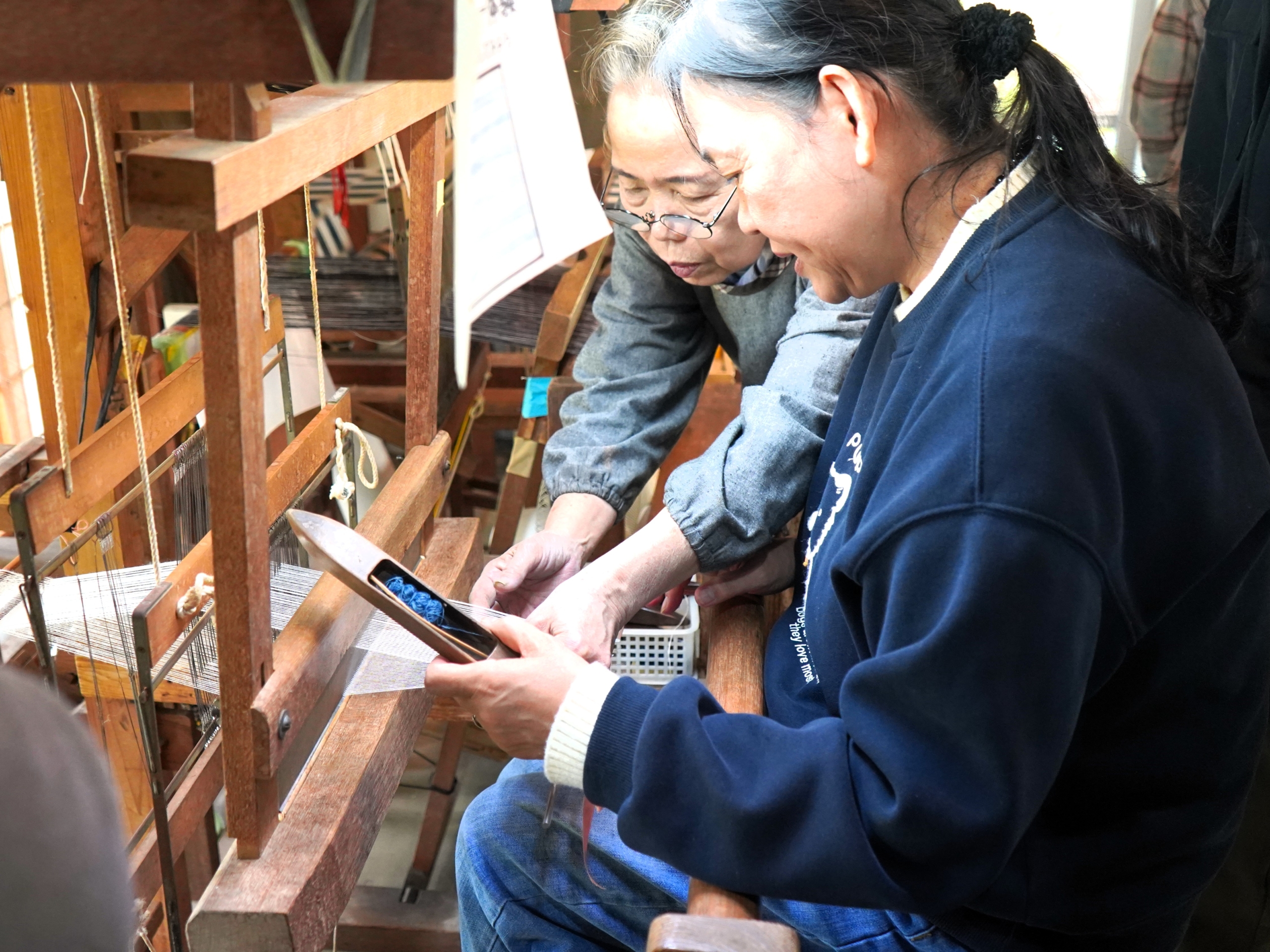
In the afternoon, participants drew their coaster designs before weaving them on Japanese treadle looms using a plain-weave technique. The warp consisted of cotton yarn prepared by Matsutake, while the weft incorporated ramie yarn, including yarn made by the participants that morning. Operating the pedals to raise the shafts while passing the shuttle by hand introduced the coordination involved in this weaving method. Participants also observed shuttle construction, yarn changes, and edge-finishing techniques.
When participants made mistakes, dropped shuttles, or broke warp threads, Matsutake patiently demonstrated repairs and encouraged them to continue. In response to questions, she also showed how shifting the colored sections of kasuri-dyed yarn creates wave patterns. Beyond technical knowledge, the exchange revealed an artisan’s calm and gentle approach to materials, teaching, and challenges.
Yomitanzan Hanaori and the Pottery Village in Okinawa
On January 29, the delegation visited the Yomitanzan Hanaori Cooperative on Okinawa’s main island to learn about the revival of hanaori weaving and its techniques. Yomitanzan hanaori uses hand-picked and float-weaving techniques to create geometric patterns with a raised texture. Its windmill, coin, and fan motifs express wishes for longevity, prosperity, and happiness, and can be developed into many variations.
Through exhibition areas, classrooms, and practical workspaces, the cooperative connects historical interpretation, technical learning, and product development. Alongside traditional textiles, it combines hanaori with leather and everyday objects and incorporates weaving themes into language-learning cards, offering ideas for cultural education. The team also observed similarities in symmetry between some hanaori patterns and Atayal weaving motifs, opening possibilities for further exchange.
The delegation then visited Yomitan’s pottery village to observe a craft community formed around climbing kilns, workshops, and galleries. Individual makers maintain distinctive styles, producing both artworks and everyday tableware. The open, informal walking routes allow visitors to explore and encounter craft production directly, providing ideas for local craft exhibitions and exchange spaces.
Reflections and Future Directions
The visit encompassed ramie processing, yarn making, and hands-on weaving, as well as cultural education, product design, and craft communities. The team saw that sustaining traditional skills requires participation from artisans, learners, and local communities, together with continuing connections to everyday life.
The project will discuss appropriate tool improvements, ramie fiber comparisons, and educational applications with local partners. Grounded in respect for Atayal culture and craft knowledge, the team will continue exploring new possibilities for weaving culture and building opportunities for Taiwan–Japan exchange and collaboration.
Written by Hsu, Yu-Chun
Edited by Li, Ruo-Jia
Photos by Tsai, Shyi-Jeng and Hsu, Yu-Chun