
In January this year, National Central University’s mbhoyaw “Fuxing” University Social Responsibility (USR) Project team visited Kimiko Matsutake at Dyeing Studio Nawata on Ishigaki Island. The team learned ramie processing, yarn making, and Japanese treadle loom operation, while her demonstrations introduced natural plant dyeing and the techniques used to create Yaeyama jōfu patterns. To continue this exchange, the team returned during the summer to further explore yarn dyeing and patterned weaving.
The trip also included visits to other weaving regions in Japan, including Miyako jōfu on Miyako Island, Yomitanzan hanaori in Okinawa, and Echigo jōfu, Ojiya chijimi, and Shiozawa silk textiles in Niigata. By observing weaving techniques, cultural preservation, and promotional approaches, the team gathered ideas for future exchanges and activities.
Understanding Yaeyama Jōfu Through Plant Dyeing
The distinctive qualities of Yaeyama jōfu lie not only in its handmade ramie yarn but also in natural plant dyeing and intricate pattern design. During the morning session, Matsutake introduced direct dye application, resist dyeing, and their associated weaving methods, then guided the team through a yarn-binding exercise. In the afternoon, participants dyed their yarn with indigo and wove bookmarks, discovering how patterns emerge as threads interlace.
Matsutake’s home combines living and working spaces, revealing thoughtful touches that connect weaving with everyday life. Using a work in progress, she explained the colors produced by plant dyes: indigo provides blue, fukugi provides yellow, and the two can be combined to create green. Kōro produces brown and is also known as shulang, a dye material commonly used in Atayal textiles.
Direct dye application requires calculating the spacing of patterns, securing the warp and weft yarns on frames, and applying dye with a bamboo pen. Measuring guides help align the dyed sections and minimize errors. During weaving, the arrangement of warp yarns and adjustments to the weft must work together to produce the intended pattern. From fine yarn to finished cloth, every stage relies on the artisan’s patience and experience.
Matsutake also shared an obi textile that would soon be sent to a kimono merchant in Kyoto. She designs her work freely, and the merchant respects her creative choices, demonstrating a relationship of trust between artisan and retailer. Her daughter, Mirai Matsutake, also presented a work combining Yaeyama jōfu with hanaori. It illustrated possibilities for both continuity and innovation, as well as the joy of mother and daughter sharing a commitment to their craft.
Dyeing Yarn and Weaving Our Own Patterns
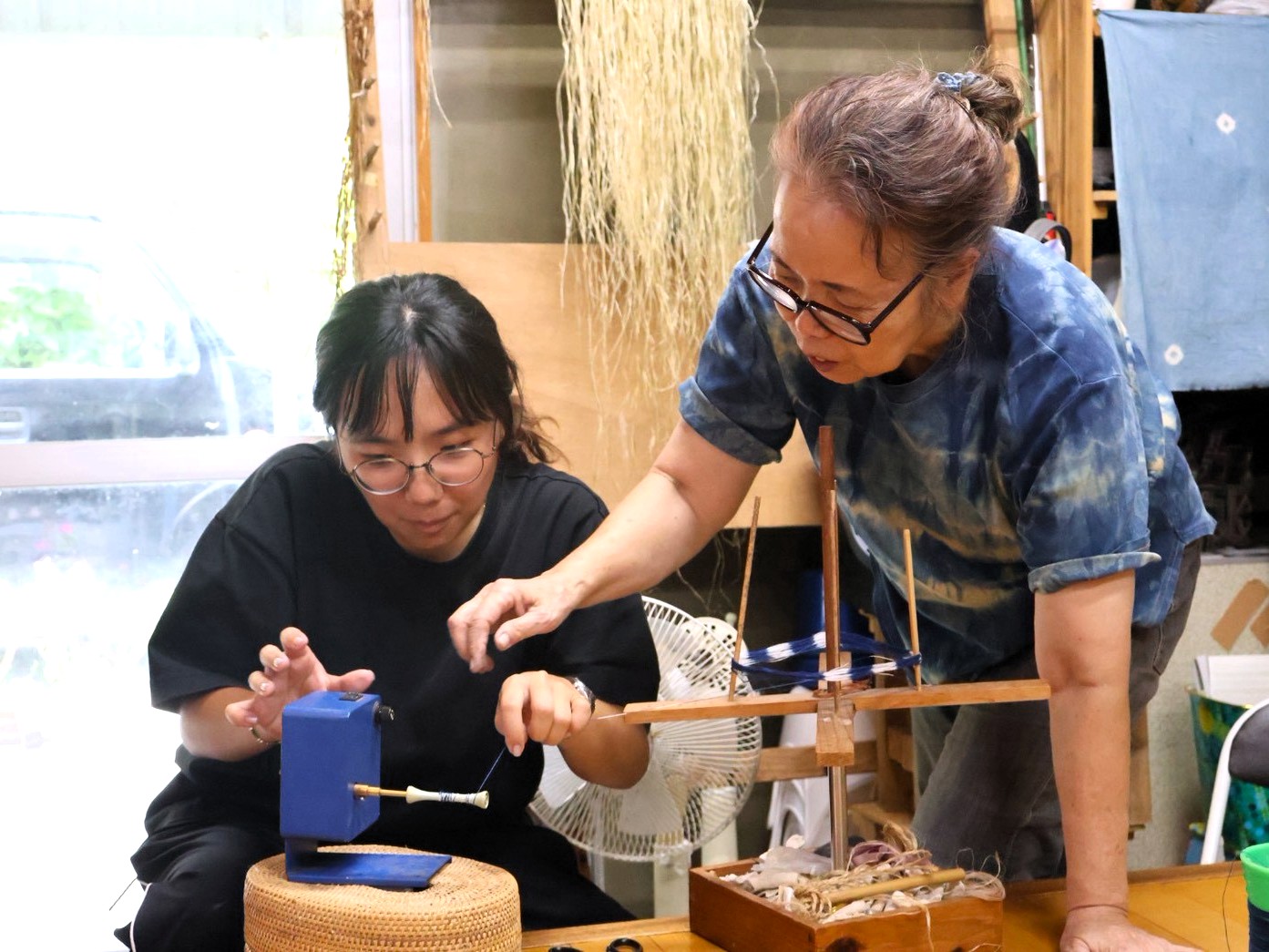
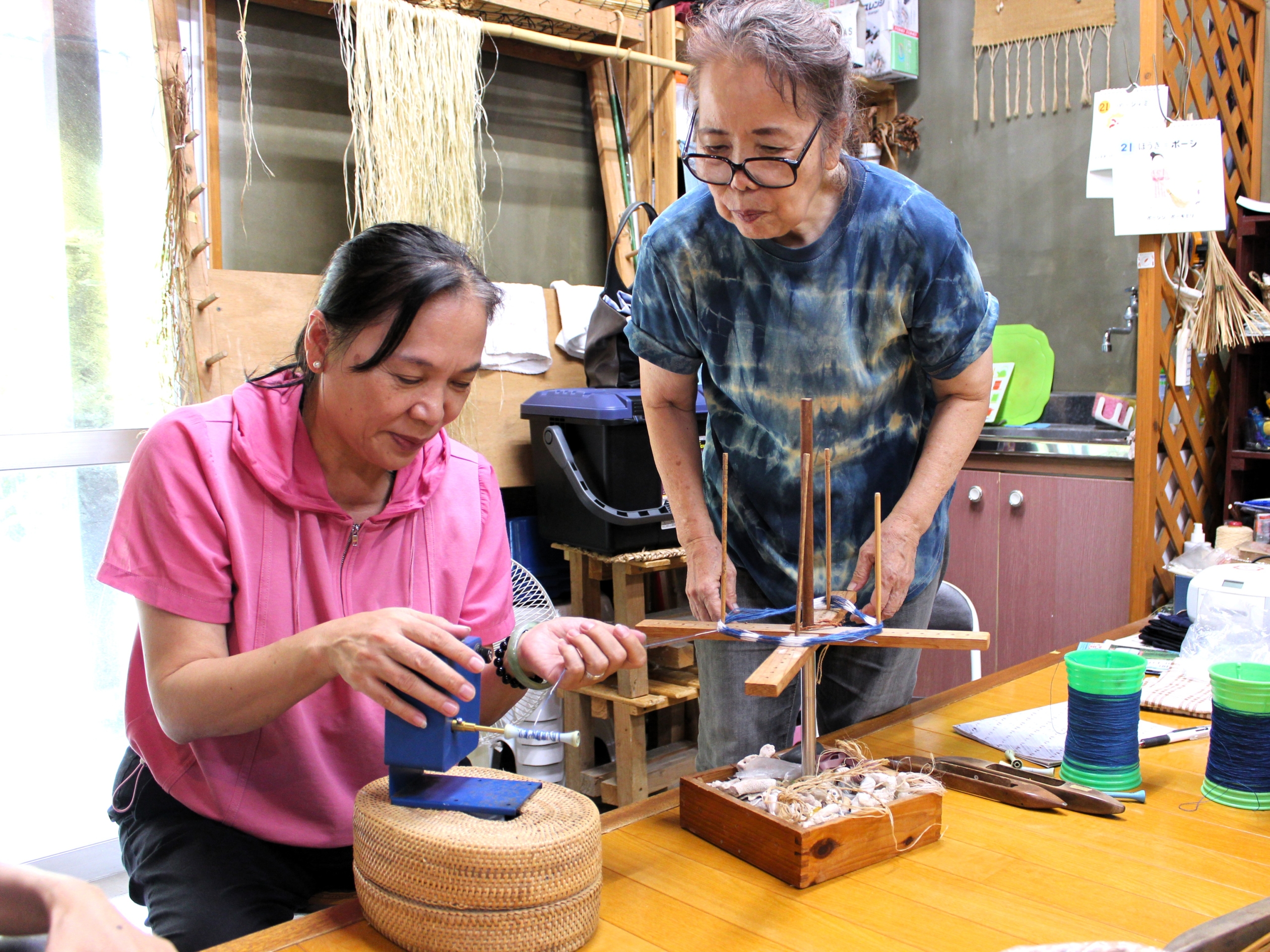
The resist-dyeing exercise used cotton yarn. Participants first wound the yarn around metal rods mounted on wooden frames, then marked the required positions using measuring guides. Plastic strips and cord were tightly wrapped around the sections that were to remain undyed, preventing dye from penetrating and creating white areas. The length, position, and number of these areas form the basis for subsequent pattern variations.
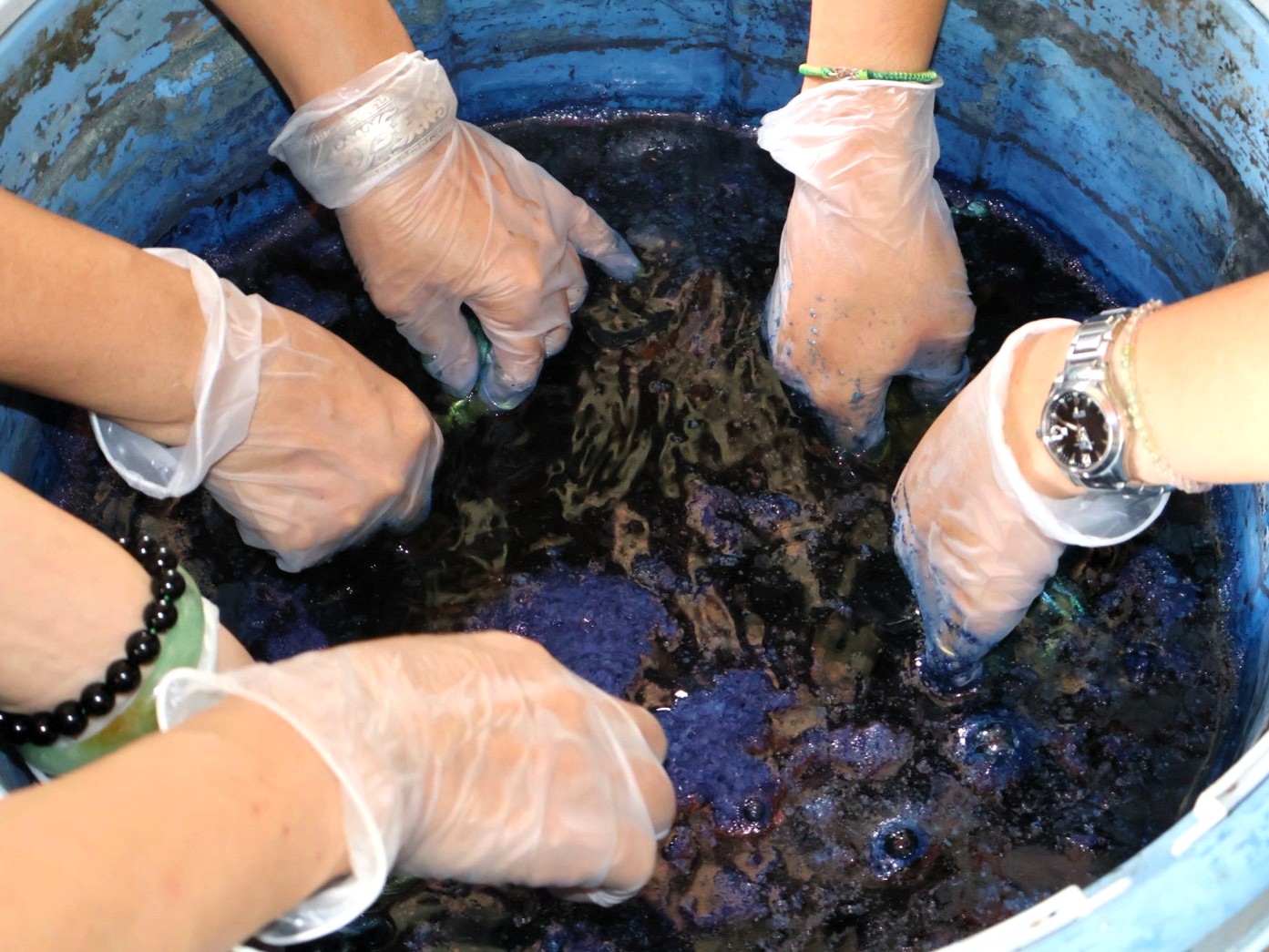
In the afternoon, the team immersed the bound cotton yarn in an indigo vat, then removed it and exposed it to air, watching the color change from green to blue. Repeated dipping and oxidation gradually deepened the color. Participants learned that indigo dyeing requires careful timing and a steady rhythm of operation. After dyeing and subsequent treatment, they removed the bindings, wound the yarn onto bobbins, and placed them in shuttles for weaving.
Yaeyama jōfu uses plain weave as its foundation. Patterns are created by adjusting the position of the weft so that the dyed and undyed sections form different arrangements. Matsutake offered attentive guidance throughout, helping participants understand how shifts in the yarn affect the pattern. The team completed wave and arrow motifs and experimented with original designs, experiencing the flexibility of this weaving method firsthand.
Having watched Matsutake demonstrate wave patterns in January, participants were now able to weave them themselves. Repeated practice transformed observation into a deeper understanding of the technique. These seemingly simple adjustments depend on judgment developed over many years, giving the team a greater appreciation of the effort behind every handwoven piece.
Sustaining Exchange and Friendship Through Weaving
The team is grateful to Kimiko Matsutake and Mirai Matsutake for their patient teaching and generous sharing of techniques and creative experience. Thanks also go to interpreter Hanami Takana for facilitating communication and helping make the learning experience possible. The team presented a certificate of appreciation and shared photographs from the January visit, renewing their connections through group photographs and warm embraces.
This visit deepened the team’s understanding of plant dyeing, pattern design, and craft transmission, while providing new material for Atayal weaving education. The team looks forward to continuing to learn alongside local partners and sustaining the friendships and cultural dialogue established through weaving.
Written by Hsu, Yu-Chun
Edited by Li, Ruo-Jia
Photos by Hsu, Yu-Chun