
This time, I had the privilege of serving as a student reporter, documenting a meaningful cultural exchange as students from Luofu High School in Fuxing District, Taoyuan, visited National Central University for a unique Weaving Culture Workshop. More than just a class, it was a vibrant dialogue across generations, cultures, and disciplines.
These students from the mountains may be young, but they’ve already demonstrated remarkable weaving skills. Immersed in Atayal traditions since childhood and trained continuously at school, they are fluent in the art—from thread arrangement, the rhythm of warp and weft, color matching, to the symbolic meanings behind each pattern. Watching them work with such focus and finesse, I realized that cultural heritage isn’t preserved by words alone—it is passed down through hands-on practice, dedication, and heart.
One of the most surprising and inspiring moments of the day was seeing the “Weaving Simulator”—a digital tool designed by students from the College of Engineering. By integrating what they learned in class with their own technical backgrounds, they created a platform where users could simulate the weaving process digitally—adjusting colors and patterns and seeing the results in real time. This idea was sparked after they studied Indigenous weaving culture in their elective course and imagined how technology could serve as a bridge between innovation and tradition.
What left the deepest impression on me was the moment the Luofu students began interacting with the simulator. They weren’t just playing—they were applying their weaving knowledge to design meaningful digital patterns. When their creations came to life on the screen, their faces lit up with joy and pride. One student even exclaimed, “This is the fabric I want to weave in the future!” At that moment, I felt I was witnessing a genuine fusion of culture and technology—a glimpse of something truly new being born.
Even more touching was how the university students, coming from an engineering background, gained a renewed respect for traditional craft. Through interviews, observation, and hands-on interaction, they began to think beyond just “building a tool.” They started asking deeper questions: How can more people come to appreciate the value of Indigenous weaving? How can digital technology become a tool for cultural connection, not just a product? Their creation became more than a class project—it became a shared mission rooted in empathy and curiosity.
As a student reporter, I wasn’t just observing from the sidelines—I was part of the story. Initially, we thought we were here to “offer” something to the students from Luofu. But in the process, we found ourselves learning from them—rediscovering the essence of culture and creativity through their eyes. Their passion and determination were pure, powerful, and deeply inspiring—something we rarely get to encounter so directly in higher education.
What I’ve come to believe is this: cultural innovation isn’t about replacing tradition, but about reinterpreting it with care and context. This USR project is a wonderful example—where university resources meet community needs, and student expertise merges with local culture. Education, in this sense, becomes more than the delivery of knowledge—it becomes the practice of shared values.
As the students left the campus, I felt a new hope growing quietly inside me—a spark ignited by the meeting of tradition and technology. I began to imagine: What if, in the near future, we see weaving tools powered by AI or VR? What if more Indigenous youth record and share their stories in their own voices? What if more university students stepped into rural communities, using their skills to serve where it matters most?
This wasn’t just a class. It wasn’t just a project. It was a journey—one about understanding, respect, and co-creation. And I feel truly honored to have witnessed it.


Written by Sun, Yi-xin
Edited by Li, Ruo-Jia
Photos by Sun, Yi-xin
Surrounded by verdant mountains and flowing streams, Nan San Village in Tai’an Township, Miaoli County—home to eight Atayal tribes—rests quietly along the river valleys and hillsides of the Da’an River. In these mid-elevation mountains, dense foliage softens the harshness of July’s sun. Together with students from Luofu High School, we stepped into the forest and into an immersive journey of cultural exchange with the Atayal people.
The journey began with a walk across the Xiangbi Suspension Bridge, which spans the Da’an River and sways gently beneath each step. Only 15 people can cross at a time, adding a thrill to the crossing as the suspended structure hung above the deep gorge. Beyond the bridge, we followed an old trail marked by fading painted railings, winding through a bamboo forest, and eventually arrived at Xiangbi Tribe. In the Atayal language, “Xiangbi” means guava, while its Chinese name—“elephant trunk”—was inspired by the mountain’s silhouette during the Japanese colonial period.
At the village entrance, the characters “Xiangbi” were carved into the stone by an irrigation channel that diverts water from the Da’an River to nourish local crops, sustaining generations of tribal families. After enjoying a meal rich in Atayal flavors, we explored the tradition of Atayal archery. The bows, long and straight, appear light but hold generations of hunting wisdom. With arrows notched and bows drawn, we released our shots in silence. The arrow cut through the air and struck the wild boar-shaped target, its impact symbolizing our growing connection to the land and its stories.
We continued on to the Tengu Tribe, where we visited the home of the chief of the Beishi Atayal group. The first to greet us was the former chief, now elderly but still active in preserving tradition. He continues to gather rattan from the mountains and hand-weave it into baskets—each one a product of great care, skill, and memory. A tribal elder sang an ancient Atayal chant for us. These chants were once used to resolve disputes and have no fixed lyrics; they’re improvised in response to the moment. That day, her song expressed thanks for our visit, her voice drifting gently like a breeze through the forest.
The current chief later joined the conversation and spoke of Atayal myths, local history during Japanese rule, the influence of Catholic and Han folk religions on tribal rituals, and his concerns about the loss of language and tradition. His words revealed the depth of a leader committed to cultural preservation. One moment stood out: his grandfather had led a resistance against Japanese forces, while his father expressed gratitude for the improvements brought by Japanese administration. The chief himself remained neutral. He believes that every view is shaped by its time and context—there is no absolute right or wrong.
Later that day, we visited Lianzhui Workshop to try our hand at weaving decorative ornaments. We passed our needles through interlaced warp threads, building fabric one layer at a time. The instructor did not teach us how to tie off the threads—traditionally, the tightness of the weave is enough to secure the textile. After two and a half hours of effort, we had completed only about 10 square centimeters. It was a humbling glimpse into the time and patience required for a single piece of traditional clothing.
At dawn the next day, we joined a field walk through the Da’an Tribe. The winding trail offered misty views of distant ridgelines as the morning sun broke through. We passed logging sites, vegetable gardens, narrow paths, and a True Jesus Church. Quiet moments along the trail revealed the slow, steady rhythm of daily life in the mountains.
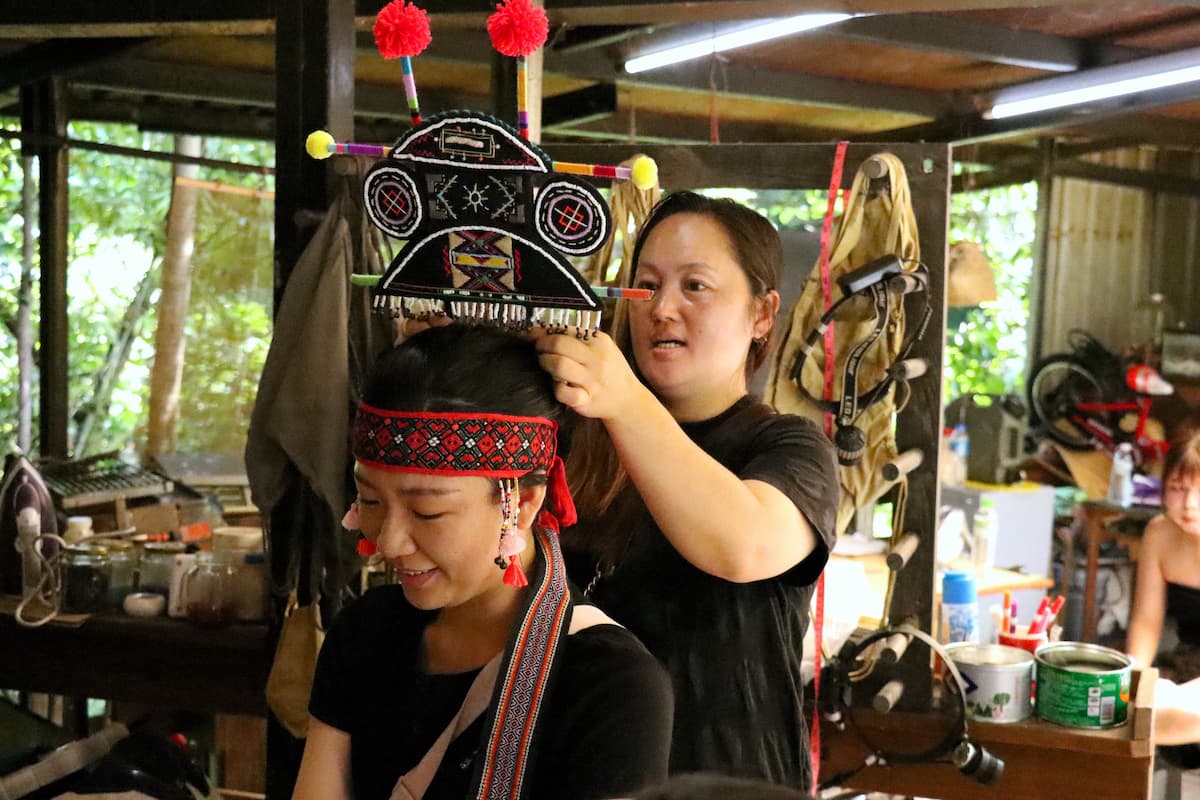
Our final stop brought us back to Lianzhui Workshop to create family crest keychains. The family crest, unique to the Beishi Atayal group, is a woven symbol traditionally worn on a bride’s forehead. While patterns vary freely, the frame must be made from bamboo grown in sunlit areas to ensure strength. The instructor showed us a crest she had woven for her future daughter-in-law: colorful threads ran across black fabric, with pure white tassels hanging from the base—a symbol of love and hope for the future.
As the sound of cicadas echoed through the warm summer air, we stitched quietly, bringing our cultural journey to a close with reflection and gratitude.
Crossing suspension bridges, listening to oral histories, and learning the art of weaving allowed us to go far beyond what books and screens can offer. This two-day, one-night textile craft and cultural experience camp offered us a living connection to Atayal life. It was more than a cultural exchange—it was a heartfelt lesson in humility, empathy, and understanding.
We return with the hope that we, too, can become bridges between cultures—carrying forward the stories, the skills, and the spirit shared with us over these two unforgettable days.


Written by Shu, Cheng-Jui
Edited by Li, Ruo-Jia
Photos by Shu, Cheng-Jui
“Lokah!” a warm voice rang out as a cheerful woman greeted Yuri with heartfelt enthusiasm. Yuri responded in kind, her energy just as vibrant. Curious, I turned to her and asked what the word meant. She told me that “Lokah” is Atayal for “keep going” or “you can do it”—a phrase full of strength, encouragement, and solidarity.
This textile craft and cultural experience camp, organized by Luofu High School, was guided by three wonderful teachers. Each of them was approachable, kind, and free of any air of hierarchy. They laughed and chatted with us like old friends, not educators holding court. Throughout the journey, I learned a great deal from them—about Indigenous culture, language, and everyday life—and felt as if I, too, had absorbed a bit of their optimism and warmth.
But the experience went far beyond weaving. While the camp aimed to foster exchange between Indigenous communities from Taoyuan and Miaoli, it was also an eye-opening journey for people like me, outsiders to this world. One of our first challenges was crossing a towering suspension bridge. With each wobble underfoot, I found myself appreciating the solid sidewalks I take for granted back home. Our guide, with a smile, shared that he used to cross this very bridge every day on his way to school—an act that filled me with admiration and humility.
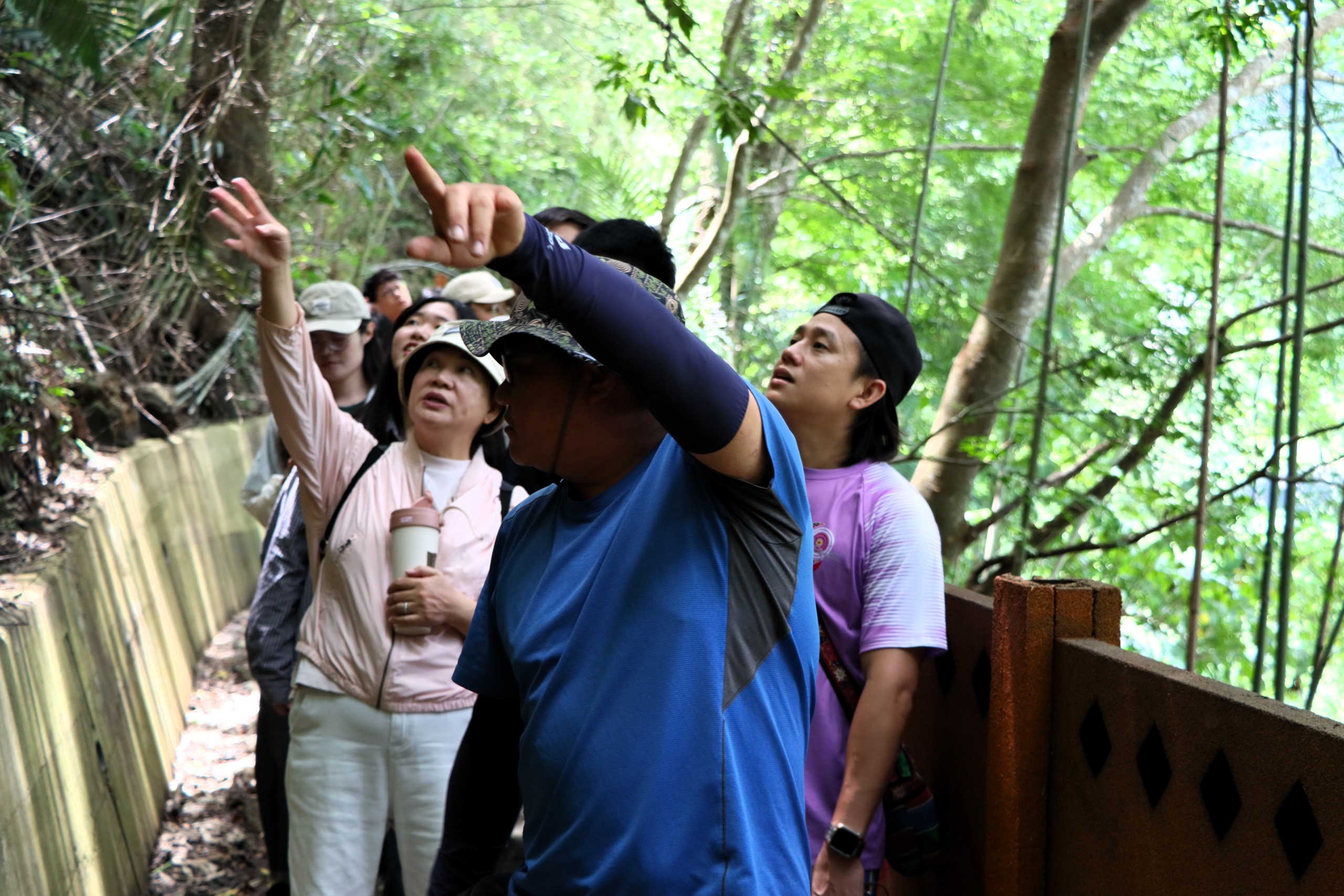
As we walked, the guide introduced us to a rich variety of native plants. With the effortless ease of someone who had grown up among them, he explained their medicinal uses, edibility, and growth habits. Unlike city kids like myself, for whom this was entirely new, such knowledge is second nature to those who live in the mountains. This harmony between people and the land left a deep impression on me.
During the weaving workshop, I learned about the symbolism and aesthetic philosophy behind Atayal patterns. To my surprise and delight, Yuri praised my weaving as neat and even said I might have potential as her apprentice. Though I briefly imagined whether such intricate work could be replicated through automation, I quickly realized that the true value of these crafts lies in the care and individuality that only human hands can offer—just like the warmth and hospitality we received from everyone in the community.
One of the most unforgettable moments of the trip was visiting the home of the tribal chief’s family. The former chief, now an elder, is a master of rattan weaving. He shared not only his craftsmanship, but also stories of the tribe’s history and cultural heritage. Another elder, an expert in traditional Atayal chanting, sang for us. Her voice was ethereal, like something carried on the wind. Atayal chants do not have fixed lyrics; they are improvised in the moment to reflect what the singer feels. That day, she sang to welcome us.
Later, the current chief—son of the elder—joined the conversation and shared stories about Atayal traditions, rituals, and ways of life. He spoke thoughtfully, dispelling many of my preconceived notions. One story in particular stood out: his grandfather had led the tribe in resistance against Japanese forces, while his father, having witnessed the improvements in infrastructure under Japanese rule, felt gratitude. The chief, however, doesn’t take sides. “Everyone is shaped by their time,” he said. “There’s no absolute right or wrong—just different perspectives born from different circumstances.”
Among the many things he shared, I was most fascinated by the tribe’s way of marking time—by the moon. Instead of counting days, they would say things like, “See you in a few moons” to make future promises, such as arranging a marriage. I think I’ll start saying that to my friends too. “A few moons from now.” Doesn’t that sound poetic?
I’m sincerely grateful to all the staff and students who took part in this journey. True cultural understanding can’t be gained from textbooks alone—it requires stepping into unfamiliar places, listening deeply, and allowing yourself to be changed. What we read in school about Indigenous cultures barely scratches the surface. If you’re curious, I encourage you to plan a trip of your own. Go on a cultural pilgrimage and discover what lies beyond the page.
And finally, a reminder to myself—and to anyone navigating life’s inevitable obstacles: whenever you make it through something tough, don’t forget to say to yourself, with strength and pride—Lokah.


Written by Su, Chih-Hsien
Edited by Li, Ruo-Jia
Photos by Su, Chih-Hsien